
What concrete measures allow struggling parents to regain some maneuvering room in their daily lives? Between recent financial aid, organizational strategies, and emotional support resources, the levers vary depending on the family situation. The ten tips that follow each target a specific problem, with verifiable data when possible.
1. Activate child care assistance for job seekers

Related reading : The best tips for easily posting and finding ads in France
Since May 1, 2024, Child Care Assistance (AGE) is available to all job seekers who return to work or training with at least one child under 12 years old. It covers part of the child care costs for up to 12 months.
This measure addresses a documented barrier: the inability to resume work due to a lack of financial solutions for child care. Several tips for helping parents in difficulty remind us that child care remains the primary obstacle to employment for single-parent families.
Related reading : The latest trends and tips for better managing your finances daily
The application is made through France Travail, with proof of resuming work or entering training. Payments are retroactive if the documents are provided on time.
2. Request the Family Support Allowance for single parents

The ASF compensates for the absence or insufficiency of child support. Its amount was raised to 187.24 euros per month per child as of April 1, 2024, and then increased to 200.78 euros on April 1, 2026.
This two-year progression reflects the specific precariousness of single parents facing unpaid child support. The allowance is paid by the CAF without income conditions as long as the parent solely bears the responsibility for the child.
3. Apply for the Daily Parental Presence Allowance in case of serious illness

The AJPP allows a parent to stop or reduce their work to care for a child with a serious illness or disability requiring intensive care. The right is granted based on a detailed medical certificate.
Residence conditions have recently tightened, making the application process more demanding. Checking the current criteria with the CAF before submitting the application can prevent a refusal for administrative reasons.
4. Set age-appropriate screen time limits

Screen time is one of the most common sources of tension between parents and children. Setting a clear rule (duration, time slots, types of content allowed) reduces daily negotiations.
Effectiveness relies on consistency: a limit applied four days a week loses its credibility. Displaying the rules on a visible medium (board, refrigerator) allows the child to refer to them without the parent having to repeat.
- Define a specific time slot rather than a vague quota (for example, after homework, not “one hour a day”)
- Turn off notifications from non-educational apps during school hours
- Offer a concrete alternative activity to avoid a void after screen time
5. Build a support network among parents in the same neighborhood

Isolation amplifies every parental difficulty. A local network, even informal (three or four families), allows for sharing occasional child care, school runs, or simply a space to talk.
Community centers and neighborhood associations often offer support groups or parent cafés. These structures exist in most municipalities and require no membership fee.
6. Learn to identify the child’s emotions before reacting

In the face of a tantrum or refusal, the parent’s first reaction sets the tone for what follows. Naming the child’s emotion (“you are frustrated because…”) reduces the intensity of the conflict faster than a harsh prohibition.
Recognizing the emotion does not mean accepting the behavior. This distinction is the foundation of emotional regulation: we validate what the child feels, we reframe what they do.
7. Delegate one household task per week to each household member
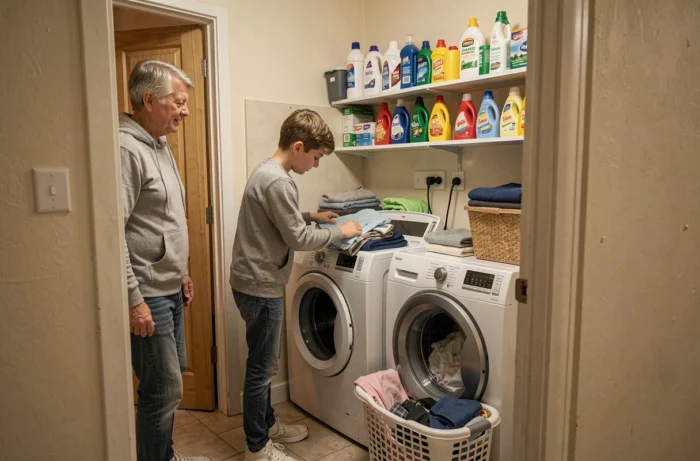
The parental mental load decreases when responsibilities are visible and shared. Assigning a fixed task each week to each child (based on age) turns participation into a habit rather than a favor.
A six-year-old can set the table. A teenager can manage a full laundry load. Regularity matters more than the perfection of the result.
8. Check eligibility for grants and specific assistance for single-parent families

Beyond the ASF, several measures target single-parent families: increased housing assistance, social pricing for school meals, partial exemption from extracurricular fees. A common issue is non-utilization due to lack of awareness.
Online simulators from the CAF and some local authorities allow individuals to check their rights in just a few minutes. Non-utilization of assistance particularly affects single parents, often due to a lack of time to complete the necessary steps.
9. Preserve a non-negotiable weekly personal time slot

The parent’s mental health affects the quality of their support for the child. Blocking a fixed time slot each week (even two hours) for a personal activity is not a luxury; it is a preventive measure.
This time slot works when it is scheduled in the agenda just like a medical appointment. Entrusting it to another trusted adult or synchronizing it with shared child care makes it realistic even for a single parent.
10. Consult a professional at the first signs of parental burnout

Parental burnout manifests as emotional detachment from the child, disproportionate irritability, and a sense of loss of competence. These signals often precede a broader decline in health.
Consulting early reduces the duration and intensity of the episode. PMI, family centers, and some CAF services offer free consultations with psychologists or parenting advisors.
- PMI (Maternal and Child Protection): free consultations without income conditions
- Family centers: collective or individual support depending on the structure
- Specialized helplines (such as Allo Parents en crise) for an initial anonymous contact
The common denominator of these ten levers remains access to information. The measures exist, the assistance is being enhanced, and the listening structures are operational. The main difficulty for parents in fragile situations lies less in the absence of solutions than in the complexity of accessing them at the right time.