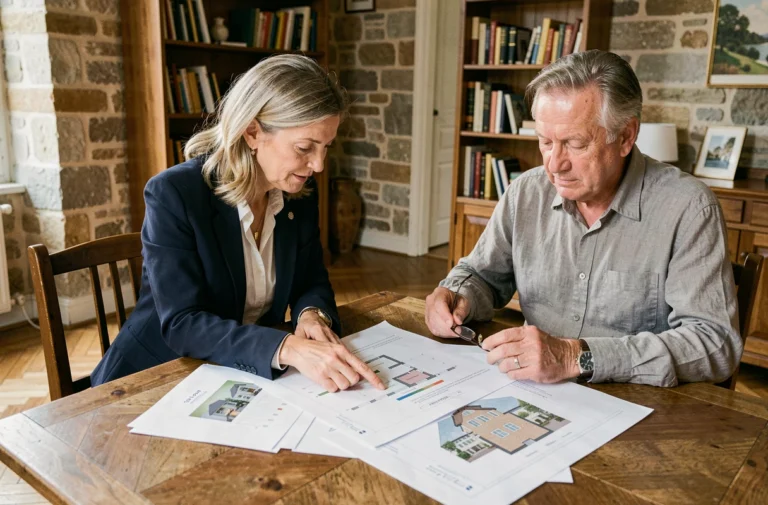
A couple signing the lease for their venue in March sometimes discovers in June that the town hall cannot celebrate the wedding on the planned date. The publication of the bans, often forgotten in the timelines, imposes an uncompressible delay: the civil ceremony cannot take place before the tenth day following the publication. Coordinating the administrative file with the venue reservation avoids this kind of calendar collision.
Administrative constraints of civil marriage in France
The civil marriage must be celebrated at the town hall, in a room open to the public. This legal obligation excludes any official celebration in a private castle or garden, even if the caterer and photographer are already booked.
The marriage file must be submitted several weeks before the desired date. The town hall then publishes the bans for ten days. This period cannot be shortened, and some highly sought-after town halls add their own scheduling constraints.
In practice, it is necessary to contact the town hall even before sending out invitations. If you have spotted a venue you like, start by visiting the Le Monde du Mariage website to identify providers compatible with your administrative schedule, then confirm the availability of the town hall. The opposite, reserving the room and then discovering a blockage at the town hall, generates stress and sometimes cancellation fees.
Wedding budget: who finances and who decides
The current trend shows that couples are increasingly financing their wedding directly. This financial autonomy changes the dynamics of the preparations: when you pay, you decide on the menu, the number of guests, and the style of the evening.
Clarifying early on who finances what avoids family tensions. A contribution from parents, even partial, often comes with expectations regarding the guest list or the choice of caterer. Setting the rules from the start, in writing if necessary, protects the family relationship and the coherence of the project.
Distributing expense items
Rather than setting a global budget and then breaking it down, better results are obtained by starting from non-negotiable items. The venue and the caterer generally absorb the largest part of the budget. Other items (photographer, florist, music) adjust around these two pillars.
- The venue determines the number of guests, the type of catering, and logistical constraints (access, noise, hours).
- The caterer represents a variable cost that directly depends on the number of covers, the type of service (seated, cocktail, brunch), and food options (vegan menu, allergies).
- The online pot is increasingly replacing the traditional wedding list, and several French platforms offer this service free of charge for the newlyweds.
Intimate weddings and multi-day formats
Weddings are tending to become more intimate. The guest list is reduced to invest more in the experience: better caterer, more unique venue, more refined decoration. Fewer guests often allows for better quality of hospitality without necessarily reducing the total budget.
The multi-day format is also gaining popularity. The brunch the next day becomes a significant event in its own right, distinct from the main reception. This second time allows guests who have traveled from afar to extend the moment, and the newlyweds to enjoy their loved ones in a more relaxed atmosphere.
Adapting the venue to the chosen format
A two-day wedding involves checking the venue’s availability for the night and the following morning. Some estates charge an extra fee for brunch, while others include it in the package. Requesting a detailed quote day by day avoids unpleasant surprises when signing the contract.
Feedback varies on this point, but a venue with on-site accommodation significantly simplifies logistics. Guests do not have to drive after the party, and the brunch the next day can be set up without additional transport.

Safety and seating plan: checks that no one does
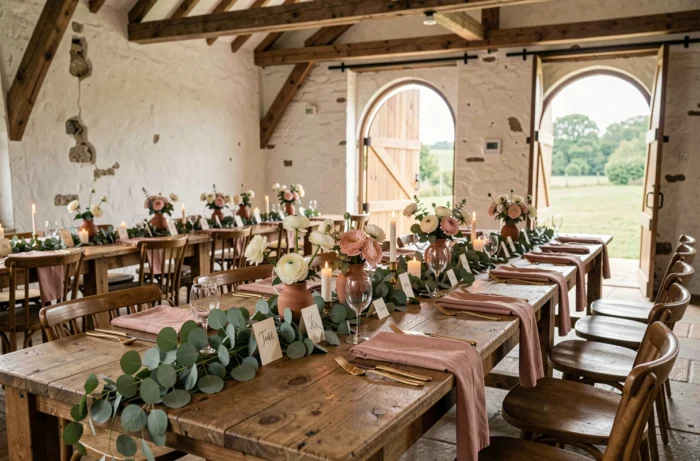
We spend hours choosing centerpieces, but often forget to check the circulation and exits of the venue. A seating plan must also be an evacuation plan. Tables too close together, emergency exits blocked by decoration, sound system cables crossing a passage: these details become real problems when the room is full.
During the venue visit, one should locate the exits, measure the spaces between the tables, and ensure that the caterer has sufficient kitchen access. If the wedding takes place under a tent (the classic backup plan for an outdoor reception), it is necessary to ensure proper anchoring to the ground and ventilation.
On-site checklist for the venue visit
- Check the number and accessibility of emergency exits, including for people with reduced mobility.
- Measure the available space between tables to allow for the caterer’s service and guest circulation.
- Confirm the authorized end times (noise disturbances) and parking rules nearby.
- Ask if the venue has a generator in case of power outages, especially for remote estates.
The choice of venue determines a large part of the experience lived by the guests. A beautiful place but poorly organized practically leaves a mixed memory. In contrast, a simple venue but well thought out in terms of circulation, comfort, and logistics makes the day smooth for everyone, including the newlyweds.