
A DIY, decoration, or gardening tool is chosen based on the material to be worked on, the type of project aimed for, and the frequency of use. Buying a generic list of tools unrelated to one’s actual needs is like filling a drawer with items that will not be used. The most effective approach is to build a foundation of versatile tools and then expand it over time with each project.
Material worked on and tools: the criterion that lists forget
The nature of the substrate determines the category of tool needed well before the type of project. Drilling drywall, concrete, or wood requires different drill bits, power levels, and torque settings.
You may also like : Successful Career Change: Key Steps for Adult Physiotherapy Training
For drywall or softwood, a cordless drill with moderate torque is sufficient for most fastenings. For concrete or solid brick, a hammer drill with a percussion mode becomes necessary, and SDS bits replace standard cylindrical bits. Confusing the two leads to wearing out the tool without results.
For cutting, the same reasoning applies. A jigsaw covers wood, melamine, and thin PVC with appropriate blades. Metal or tiles require an angle grinder with a specific disc.
You may also like : The latest trends and tips for better managing your finances daily
Before buying, one must identify the materials present in their home or garden, then work backward to the tool. Those who wish to deepen this reasoning by type of project can learn everything about Brico Déco Jardin and refine their choices based on their situation.
Assembling a DIY toolbox according to usage frequency
The frequency of use determines the level of quality. Buying professional equipment for occasional use wastes budget. Investing in entry-level tools for weekly use guarantees quick breakdowns.
Occasional use: the manual base
For spaced-out interventions (a few times a year), a well-chosen manual kit covers most common needs. It relies on hand tools whose lifespan depends solely on maintenance.
- A carpenter’s hammer, a set of flat and Phillips screwdrivers, a universal pliers, and an adjustable wrench form the core for fastening and dismantling.
- A tape measure, a spirit level, and a sturdy utility knife ensure measurement and light cutting.
- A set of basic consumables (anchors, mixed screws, medium-grit sandpaper, masking tape) prevents stalling a project due to a missing item.
This base fits in a compact case and requires no power source.
Regular use: targeted power tools
As soon as projects go beyond simple furniture assembly, two power tools radically change efficiency: the cordless drill and the jigsaw. With these two machines and a suitable set of bits/blades, one can cover fastening, drilling, and cutting on wood, thin metal, and plastic.
Favoring a single brand of interchangeable batteries reduces the total cost in the long run. Several manufacturers offer ranges where the same battery powers drills, saws, sanders, and grinders. Before buying a third tool, check the battery compatibility with the existing inventory.
Decoration equipment: painting, plastering, and finishing
Interior decoration requires less heavy tooling but demands rigorous surface preparation. The quality of the final finish depends more on sanding and protecting areas than on the number of layers applied.
The trio sander-plaster-protective tarp forms the decoration base. An orbital sander with progressively grained discs (coarse, medium, fine) prepares walls and furniture before painting. Filling compound corrects cracks and anchor holes. Tarps and masking tape protect floors and frames.
For the paint itself, a reasonably good roller applies better than a poorly adjusted sprayer. Short-pile rollers are suitable for smooth surfaces, while long-pile rollers are for textured surfaces. A trim brush completes the kit for corners and moldings.

Garden tools: adapting equipment to seasonal tasks
The garden imposes a seasonal logic that indoor DIY does not know. Pruning, weeding, planting, and soil maintenance are spread over distinct periods, and the tools follow this distribution.
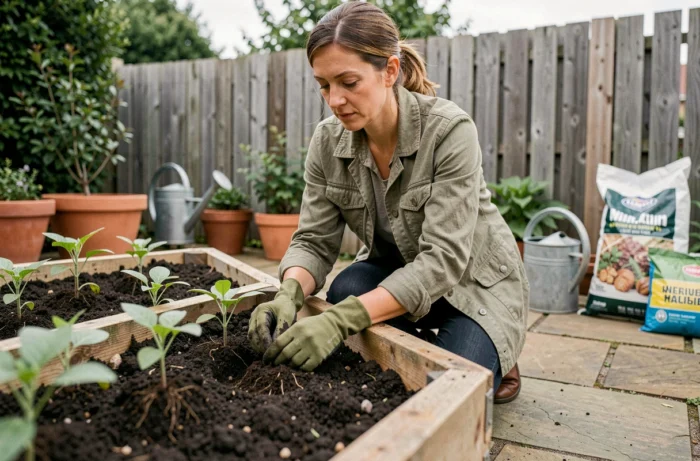
The permanent base includes a pruner, a spade, a rake, a watering can, or a hose. These four tools cover recurring tasks regardless of the season. Pruning hedges, mowing, or hoeing then require specific tools, to be acquired as the need arises.
Comfort in use reduces fatigue and injuries during prolonged work on the ground. Knee pads, a gardening mat, or a rolling stool significantly change the sustainable duration of weeding or planting. A wheelbarrow or a folding cart facilitates the transport of soil, potting mix, or green waste across medium-sized plots.
Safety and storage: two often neglected areas
Personal protective equipment is an integral part of the tools, not optional comfort. Drilling, cutting, and sanding project particles, and finishing products (paint, varnish, stripper) emit volatile compounds.
- Wrap-around safety glasses protect the eyes during any drilling, grinding, or sawing operation.
- Gloves suitable for the material (leather for raw wood, nitrile for chemicals) prevent cuts and irritations.
- A dust mask with a replaceable filter limits the inhalation of fine particles during sanding or cutting.
Storage, in turn, affects the durability of tools and the speed of access. A compartmentalized case or a perforated wall panel in a dedicated space allows each tool to be found in seconds. A poorly stored tool gets damaged, lost, and ultimately needs to be repurchased.
Building one’s equipment in successive layers, starting from the material worked on and the actual frequency of use, remains the most reliable method to avoid unnecessary purchases. Each new tool should address a blockage encountered during a previous project, not a promotion or a preconceived list.