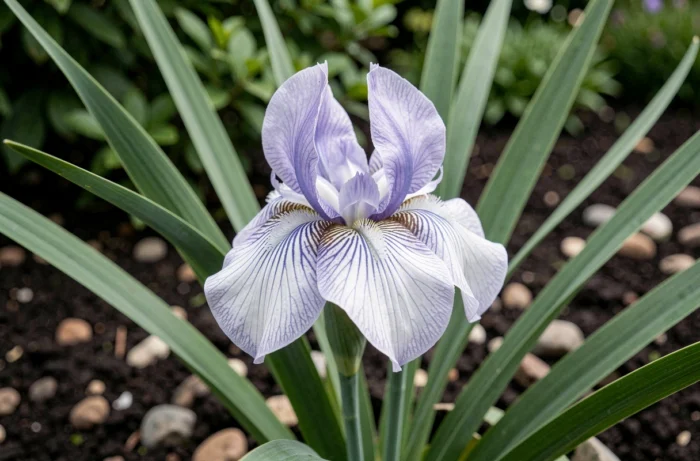
The walking iris (Neomarica northiana) produces some of the most graphic ephemeral flowers in the Iridaceae family, but its behavior in the garden remains poorly documented in France. Most French-language content focuses on pot cultivation indoors. What conditions are needed to maintain it in the ground, and how do its requirements compare to those of a classic garden iris?
Walking iris outdoors: comparative climatic requirements
Before planting a walking iris in the garden, it is essential to measure the gap between its needs and those of common bearded irises. The table below summarizes the decisive parameters.
| Criterion | Walking iris (Neomarica) | Bearded garden iris |
|---|---|---|
| Hardiness | USDA Zones 9 to 11 | USDA Zones 3 to 9 |
| Frost tolerance | Sensitive to prolonged cold below 0 °C | Withstands harsh winters |
| Soil | Very well-drained, cool in summer | Ordinary, even calcareous and dry |
| Exposure | Partial cool shade | Full sun |
| Leaf height | 40 to 60 cm as ground cover | 20 to 90 cm depending on variety |
| Spontaneous multiplication | Seedlings at the end of flower spikes | Division of rhizomes |
The gap in hardiness is the most constraining point. Prolonged cold below 0 °C in waterlogged soil destroys the rhizomes of Neomarica within a few days. In metropolitan France, only mild Atlantic coastal gardens, the Côte d’Azur, and certain urban microclimates offer conditions comparable to USDA Zones 9-11.
To find information on the walking iris with Jardinier.net, the difference in treatment between indoor and outdoor cultivation deserves to be explored based on your region.
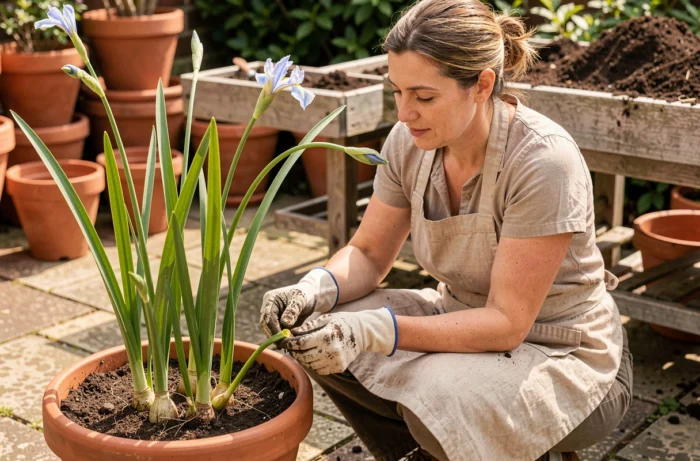
Well-drained soil and partial shade: the two non-negotiable conditions in the garden
The walking iris is native to Brazil, where it grows in open understory. Transposed to the garden, it requires cool partial shade and soil that does not retain standing water. This is the exact opposite of the bearded iris, which prefers direct sunlight and tolerates drought.
In practice, a bed oriented east or northeast, protected from the afternoon sun, works well. The soil should be amended with coarse sand or pumice if your soil is clayey. A light mulch of dead leaves keeps the soil cool without promoting excess moisture in winter.
What to do in autumn and winter
In mild climates, the foliage persists all year round. As soon as nighttime temperatures regularly drop below 5 °C, two options arise:
- Generously mulch the base with a thick layer of ferns or straw, then protect the foliage with a winter cover. This method works in areas where frost is brief and superficial.
- Dig up the rhizomes and repot them for indoor wintering, in a bright and cool room. This is the safest solution north of the Loire.
- Keep the potted plant outside all year and bring it into the garden from spring to autumn, which simplifies management without sacrificing the decorative effect in the bed.
A walking iris in a pot brought out to the garden from April to October often represents the best compromise in temperate French climates. The pot allows for drainage control and bringing the plant indoors before the first frosts.
Propagation by “walking”: using seedlings to densify a bed
The nickname walking iris comes from its mode of propagation. After flowering, the flower spike becomes heavy with a seedling developing at its tip. The spike bends, the seedling touches the ground, roots, and the plant literally “advances.”
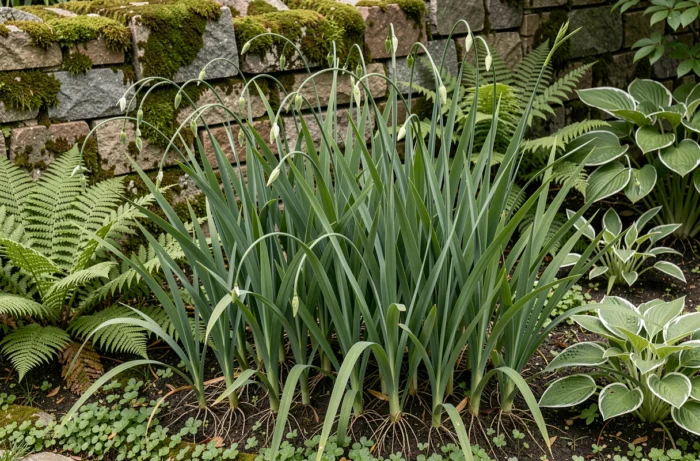
In tropical gardens in Brazil and Florida, landscapers use this mechanism to form a dense ground cover 40 to 60 cm high in just a few seasons. The plant spontaneously fills in difficult-to-vegetate areas of partial shade: footings of walls, shaded path edges, light slopes.
Accelerating colonization in the garden
To replicate this effect in mild French climates, simply guide the spikes toward the ground by weighting them with a small wire hook. The seedling roots in a few weeks in spring. Once established, cut the spike that connects it to the mother plant.
Indoors or in pots, the technique remains the same. Place a small pot of draining potting soil under the hanging seedling. Rooting generally takes a few weeks in spring or early summer. This vegetative propagation produces clones identical to the mother plant, with no genetic surprises.
Flowering of the walking iris: ephemeral but recurrent
Each individual flower lasts only one day. This brevity can be disappointing, but the plant compensates with a flowering spread over several months when conditions are right. The spikes successively produce multiple buds, maintaining visual interest well beyond a one-time bloom.
The flower resembles that of a classic iris, with white tepals marked with brown and blue. Indoors, flowering occurs more easily when the plant benefits from good indirect light and a slight temperature difference between day and night.
In the garden, in partial shade, flowering generally occurs in spring and summer. A moderate application of flowering plant fertilizer in early spring supports spike production without stimulating excessive foliage.
The walking iris remains a niche plant in metropolitan France, confined to the mildest gardens or a mixed pot/ground cultivation. Soil drainage and winter protection alone determine success outdoors. For gardeners located outside of mild coastal zones, mobile pot cultivation remains the most reliable way to enjoy its graphic foliage and unique flowers all year round.