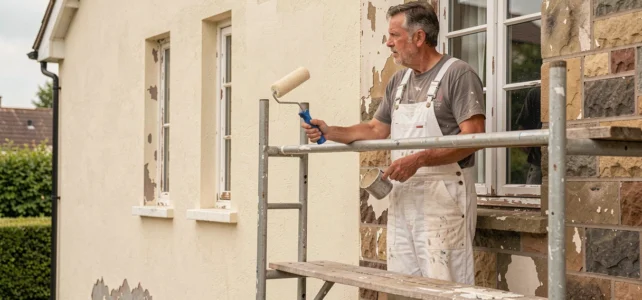
The facade painting before a sale affects negotiation, not the listed price. Renovating the facade of a property seems logical to attract a buyer, but the type of intervention chosen radically changes the financial equation. A simple refresh and a complete renovation do not operate on the same valuation levers.
Facade painting and buyer discount: the real negotiation mechanism
A repainted facade does not create net added value on the sale price. Its role is defensive: it reduces the buyer’s negotiation margin. Faced with a cracked render or a plaster darkened by moss, the buyer mentally calculates the cost of a renovation and deducts that amount from their offer, often with a generous safety margin.
Recommended read : Montpellier: discover the neighborhoods to avoid before moving to the city
The mechanism is psychological as much as financial. The state of the facade acts as a global indicator of the property’s maintenance. A buyer who notices external degradation assumes, rightly or wrongly, that the interior harbors other problems. We observe that this suspicion weighs more heavily on the negotiation than the actual cost of facade work.
In a market where properties sell more slowly, buyers use the entrance and facade as sorting criteria. A recent renovation may be enough to keep a property on the shortlist of visits, while a neglected facade excludes it even before the surface or neighborhood are compared. Requesting a quote from a facade renovation craftsman allows for precise calibration of the cost of this intervention compared to the likely discount in case of inaction.
Further reading : Discover the range of digital services to boost your online presence
Complete renovation or just painting: technical arbitration before resale
Painting alone does not address the support’s pathologies. Applying two coats of pliolite or siloxane paint on a powdery render or a cracked plaster amounts to masking a problem that the buyer’s technical diagnosis will reveal. On a healthy support, without structural cracking or infiltration, high-pressure cleaning followed by microporous painting constitutes a coherent and cost-effective intervention.

However, as soon as the support shows shrinkage cracks or peeling render, we recommend a renovation with partial render repair. The additional cost compared to simple painting is significant, but it secures the transaction: a buyer accompanied by a project manager or craftsman will immediately spot a concealed defect.
Decision criteria between painting and renovation
- Superficial crazing without infiltration: cleaning and painting the facade suitable for the existing binder is enough to restore a clean appearance without engaging in heavy work.
- Active cracks or signs of moisture at the base of the wall: a prior diagnosis by a facade specialist is necessary before any painting, or the problem may reappear within a few months.
- Render that sounds hollow when tapped: paint will not adhere durably to render that has detached from the support. Filling or render repair is a non-negotiable prerequisite.
- Facade in exposed stone or brick: painting is rarely the right answer. A colorless water repellent or partial re-pointing better enhances this type of cladding.
Renovation obligation and ITE: the regulatory framework that changes the game
The Climate and Resilience Law has strengthened insulation obligations during a renovation. When significant renovation work affects at least half of the facade surface (excluding openings), thermal insulation from the outside may become mandatory if the building does not meet a minimum level of energy performance. This obligation, codified in the Construction Code, transforms a simple aesthetic renovation into an ITE project with a vastly different budget.
For a seller, the consequence is direct. If the facade requires a complete renovation and the property is classified F or G on the energy performance certificate (DPE), the coupling of renovation-ITE becomes almost unavoidable. It is better to incorporate this expense into the overall profitability calculation rather than limiting oneself to a coat of paint that will have no effect on the energy label.
When painting alone remains relevant despite the regulatory framework
The obligation for ITE only triggers for renovation work covering a significant area of the facade. A cleaning followed by painting without render repair does not constitute a renovation in the regulatory sense, which allows one to circumvent the insulation obligation. This is a technical argument we use regularly: refreshing without triggering the regulatory threshold, provided the support allows it.

Facade and DPE: two valuation levers not to be confused
The DPE impacts the resale value of a property in a measurable and increasing way. A repainted facade does not improve the DPE by a single point. Confusing the two levers leads to counterproductive budgetary arbitrations.
If the property has a D label or better, the facade constitutes the primary visual valuation item. The buyer has no regulatory constraint to anticipate, and the exterior appearance becomes the main differentiating factor between two comparable properties.
If the property is classified F or G, investing in the facade without addressing energy performance is akin to beautifying the packaging of a product banned from rental. The buyer-investor will deduct the cost of insulation from their offer. The buyer-occupant will hesitate in the face of predictable energy bills. In this case, the facade budget has more impact if redirected towards an ITE coupled with the renovation.
Facade painting remains an effective valuation lever provided the right diagnosis is made beforehand. On a healthy support and a property correctly classified on the DPE, it removes a negotiation point at a lower cost. On an energy-consuming property or a degraded support, it masks without resolving, and the buyer always ends up noticing.